
The Financial Post West: Energy Insider Newsletter – The Q&A: Chana Martineau
Originally published June 9, 2026 in the FP West: Energy Newsletter. To subscribe visit: https://financialpost.com/newsletters/
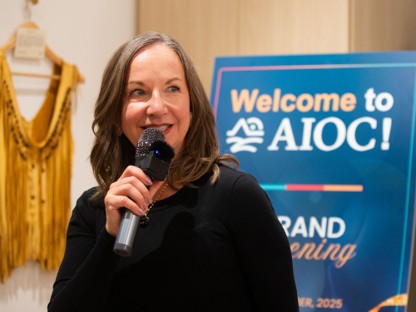
Chana Martineau, chief executive of Alberta Indigenous Opportunities Corp., in September, 2025. Photo: Brent Calver / Postmedia
A historic energy pact between Ottawa and Alberta could eventually spur development of a new oil pipeline to the country’s West Coast and a massive carbon capture network in the oilsands, known as the Pathways project.
The memorandum of understanding could also see Indigenous communities acquire a significant equity stake in these projects, if they proceed.
According to the MOU, the Smith government promised, in consultation with Indigenous leadership, that it would tap the Alberta Indigenous Opportunities Corp. to help backstop co-ownership of the pipeline and, possibly, the Pathways project.
Chana Martineau, chief executive of the Alberta Crown corporation, says the group has already set the standard for Indigenous investment in the energy sector, by providing loan guarantees.
Martineau, who spoke at the Global Energy Show in Calgary on Tuesday, told business columnist Chris Varcoe ahead of the conference that Indigenous communities are creating wealth.
Chris Varcoe: The Alberta Indigenous Opportunities Corporation was founded in 2019. How has the organization and its role evolved?
Chana Martineau: It’ll be four years here, shortly, that I’ve been in the CEO chair, to where it is today with . . . just under $750 million of loan guarantees deployed. That has supported north of $1.5 billion in Indigenous investment. There’s some senior debt on our deals as well, and 43 Metis and First Nations communities have participated.
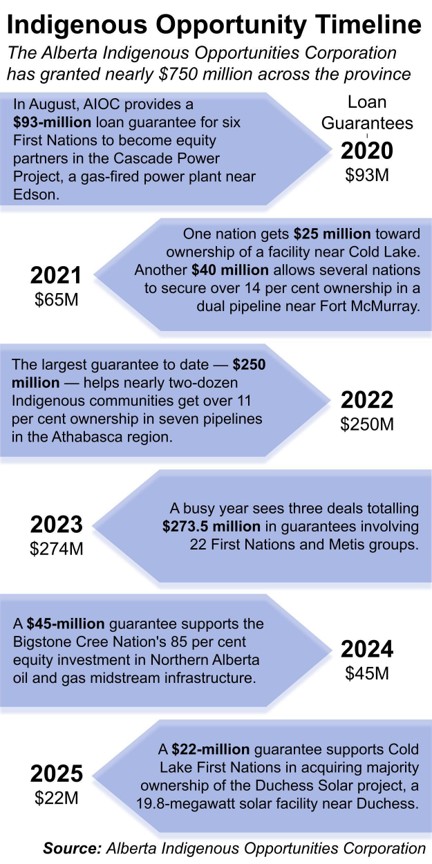
Graphic: Steven Wilhelm / Calgary Herald
Varcoe: Is there more interest now in direct equity ownership and acquiring, more specifically, majority stakes in projects than there was back in 2019, 2020 or 2021?
Martineau: I think in the early days, it was just a dream.
Our first announcements, people were just blown away that this could happen. We look at the Athabasca Indigenous investment – with 23 First Nations and Metis communities investing ($1.12 billion in 2022) in the Athabasca (pipeline) assets owned by Enbridge – and it’s almost like that transaction stopped the country and the world, and everyone took notice …
We’ve really inspired the country, and beyond, about how Indigenous partnerships can look, what is a model for economic participation, co-operation and reconciliation, that can really work for everybody involved.
When you’re a true owner, you’re really at the table making decisions. You are fully participating in shaping the project, shaping the decisions that come along with it, and you’re able to reap the rewards.
Varcoe: Now that we’ve got a few years to look back on those agreements, what impact are they having directly upon the communities and people?
Martineau: The impacts are tremendous, and we learn more and more every day. I’ll give you some dollar figures, but I’ll give you a few stories, too.
Between $25 and $30 million went into 43 communities, net of loan payments – this is after the payments – just in 2025 alone.
(I’m) super proud of that. And what are the communities doing with that money? They’re investing in infrastructure, in other revenue-generating opportunities.
One community brought in high-speed Wi-Fi for all of their residents. How do you have access to education and services without good Wi-Fi, reliable Wi-Fi?
They’re paying for their students to go to universities, investing in the future of the young people and their communities by sending their young people to university. They’re paying for their elders’ utility bills.